Systems / Performance Project
Lock-Free Ring Buffer Benchmark
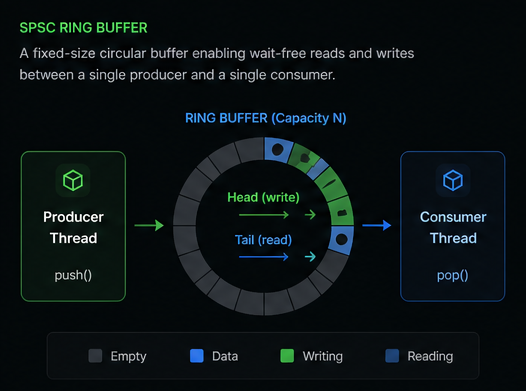
A lock-free single-producer, single-consumer ring buffer in C++ with a comprehensive benchmark suite for analyzing contention strategies, queueing behavior, and latency tradeoffs.
Key Features
- Lock-free SPSC implementation using atomics
- Four wait strategies for contention analysis
- High-resolution latency metrics
- CPU affinity support for consistent scheduling
- Capacity sweep for backpressure effects
Architecture
- Fixed-size circular buffer backed by contiguous storage
- Separate producer and consumer indices for SPSC ownership
- Acquire and release memory ordering protects data visibility
- Cache-line alignment reduces false sharing between hot atomics
- Benchmark harness is separated from queue implementation logic
How It Works
- Producer writes an item into the current tail slot
- Producer release-stores the new tail so the consumer can see the write
- Consumer acquire-loads the tail before reading from the buffer
- Consumer reads from the current head slot and advances the head
- Failed pushes mean the buffer is full, while failed pops mean it is empty
Benchmark Output
=== Throughput: Wait Strategy Comparison ===
Benchmark                  msgs/s(M)      fail_push      fail_pop
-----------------------------------------------------------------
Spin                       16.41          19             1921676
Yield                      27.38          204            32985
SpinThenYield              24.55          1499           551720
ExponentialBackoff         20.21          2645           327247

=== Latency: Wait Strategy Comparison ===
Benchmark                  avg(ns)        p50        p95        p99        max
-------------------------------------------------------------------------------
Spin                       93846.92       92441.60   106425.20  115458.20  134788.60
Yield                      78351.52       77100.00   88166.40   96366.60   139583.20
SpinThenYield              92853.83       92175.00   100424.80  110566.40  128641.80
ExponentialBackoff         98410.68       95683.60   120675.00  131950.00  174291.60

=== Throughput: Capacity Sweep ===
Capacity                   msgs/s(M)      fail_push      fail_pop
-----------------------------------------------------------------
64                         16.54          24904          1261885
256                        17.12          18212          813192
1024                       22.49          1261           694032
8192                       27.24          3653           207194

=== Latency: Capacity Sweep ===
Capacity                   avg(ns)        p50        p95        p99        max
-------------------------------------------------------------------------------
64                         6313.10        5966.80    7533.20    8774.80    75908.40
256                        23229.12       25991.20   25991.80   36441.60   40866.60
1024                       92822.79       92116.80   99266.60   116816.80  148625.00
8192                       765703.84      741950.00  934133.40  1067608.60 1311267.00
Highlights
- Lock-free SPSC queue built with C++20 atomics
- Benchmarks compare Spin, Yield, SpinThenYield, and ExponentialBackoff strategies
- Measures throughput, failed push/pop attempts, and tail latency percentiles
- Uses CPU affinity to reduce scheduling noise during benchmark runs
- Explores how queue capacity affects throughput and tail latency
- Demonstrates acquire/release synchronization in a real producer-consumer system
- Separates benchmark logic, wait strategies, formatting, and queue implementation

Performance Analysis
- Compare wait strategies under contention
- Measure throughput and tail latency
- Understand CPU scheduling impact
- Identify tradeoffs between latency and throughput

What I Learned
- Yielding improves throughput under contention
- Larger buffers increase latency due to queueing
- Backoff strategies are not always beneficial
- Thread affinity exposes true system behavior

Tech Stack
- C++20 (atomics, threads, chrono)
- CMake
- Linux (sched_setaffinity)
- Custom benchmark harness