C++ / Trading Systems Project
C++ Matching Engine
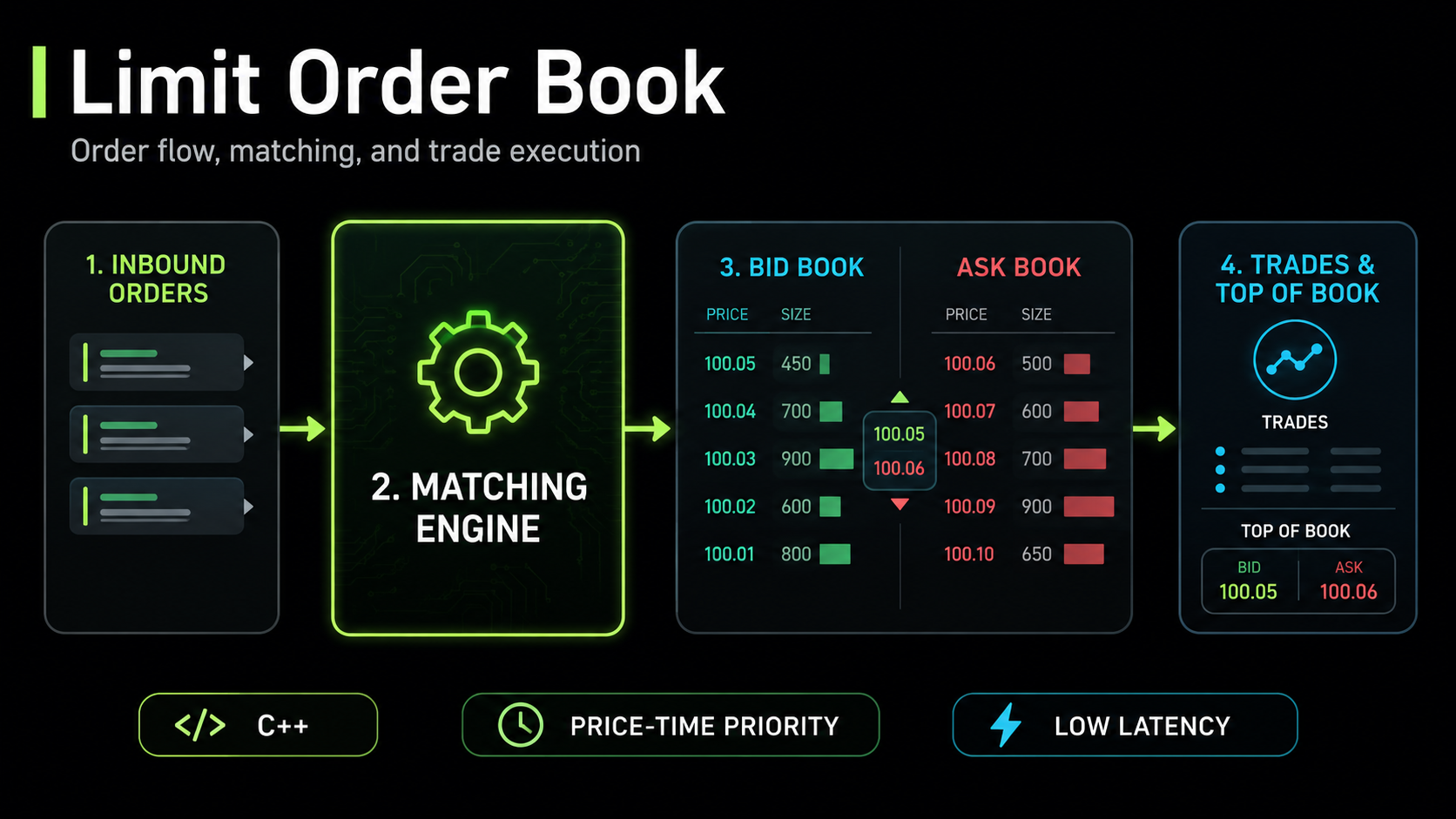
A deterministic limit order book and matching engine in C++ that models price-time priority, partial fills, cancellations, seeded order flow, and measurable engine throughput.
Key Features
- Price-time priority matching with best price first
- FIFO execution within each price level
- Partial fills across resting liquidity
- Cancellation support for resting orders
- Deterministic simulation using a fixed random seed
Matching Flow
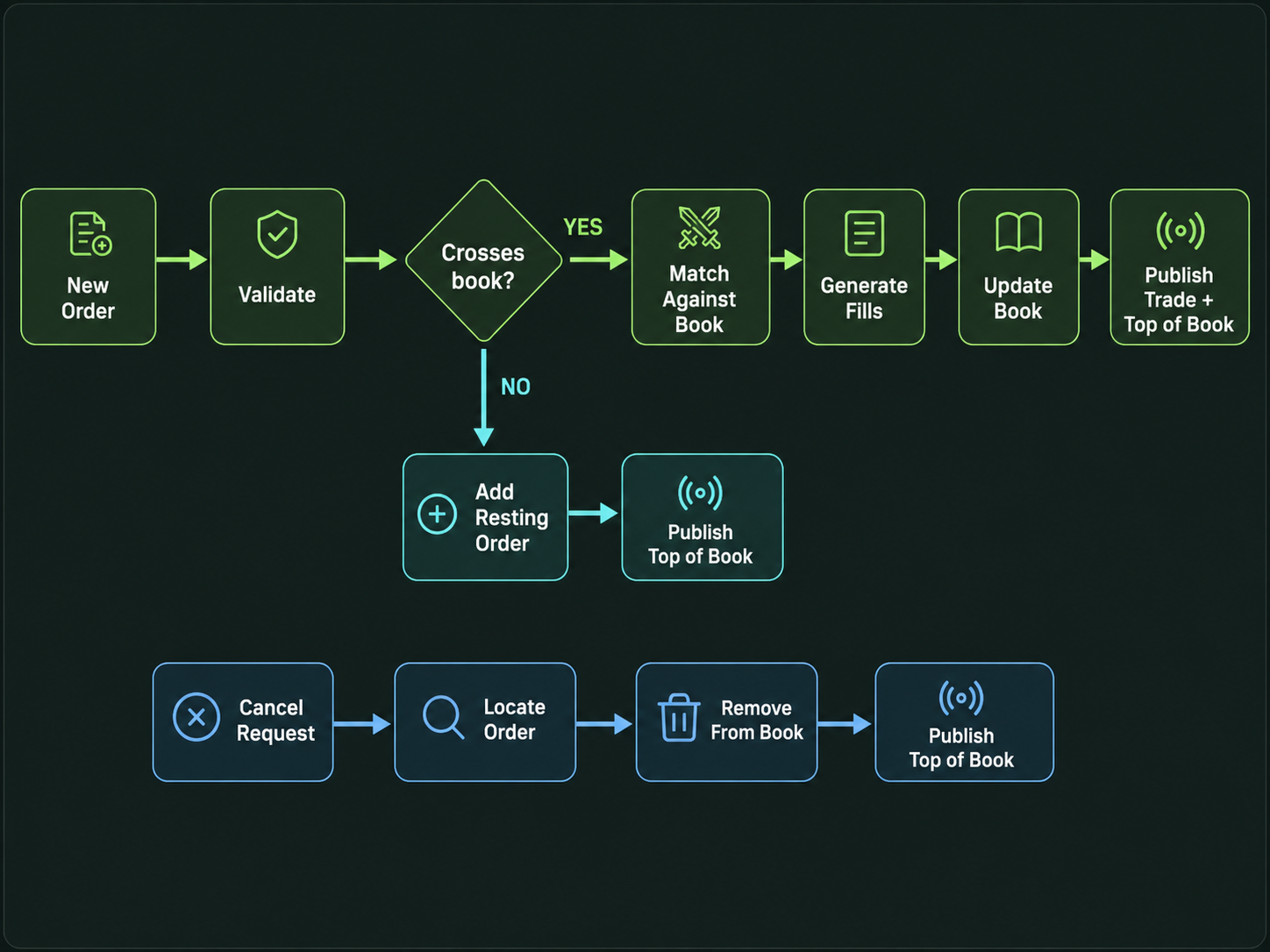
- Incoming buy orders cross against the best ask while price permits
- Incoming sell orders cross against the best bid while price permits
- Fill quantity is the minimum of incoming and resting quantity
- Fully filled resting orders are removed from the front of the queue
- Unfilled incoming quantity rests at its limit price
Architecture
- Bid side uses descending ordered price levels
- Ask side uses ascending ordered price levels
- Each price level stores orders in FIFO queues
- Simulator generates seeded add and cancel events
- Engine reports trade count, volume, spread, average trade size, and throughput
Example Engine Output
=== SIMULATION CONFIG ===

Seed:                         42
Events:                       100000

=== SIMULATION SUMMARY ===
Add Orders Processed:         80103
Cancel Attempts:              19897
Successful Cancels:           5009

=== TOP OF BOOK ===
Best Bid:                     95
Best Ask:                     96
Final Spread:                 1

=== ENGINE METRICS ===
Trades Executed:              58189
Total Traded Volume:          177043
Average Trade Size:           3.042551

Elapsed Time:                 0.051799s
Throughput:                   1,930,535.47 events/sec

Goal: model core trading-engine behavior while keeping correctness,
determinism, and measurable system performance visible.
Highlights
- Built deterministic C++ limit order book with price-time priority matching
- Implemented partial fills, resting order insertion, and cancellation support
- Modeled bid and ask books with sorted price levels and FIFO queues
- Simulated 100K seeded order events for reproducible benchmark runs
- Tracked trades executed, traded volume, final spread, average trade size, and throughput
- Separated matching logic from simulation flow for cleaner system structure
- Documented future paths for indexed cancellation, cache-friendly storage, and multi-instrument support

Execution Model
- Best price is matched first
- FIFO preserves time priority
- Partial fills carry remaining quantity forward
- Spread is derived from best ask minus best bid

What I Learned
- Correct matching rules matter before raw speed
- Deterministic seeds make performance easier to reason about
- Cancellation lookup becomes a real scaling bottleneck
- Data structure choices shape both clarity and throughput

Tech Stack
- C++17
- CMake
- std::map and std::deque
- chrono benchmark timing
- Seeded random simulation