AI Infrastructure / Validation Project
Inference Runtime Regression Gate
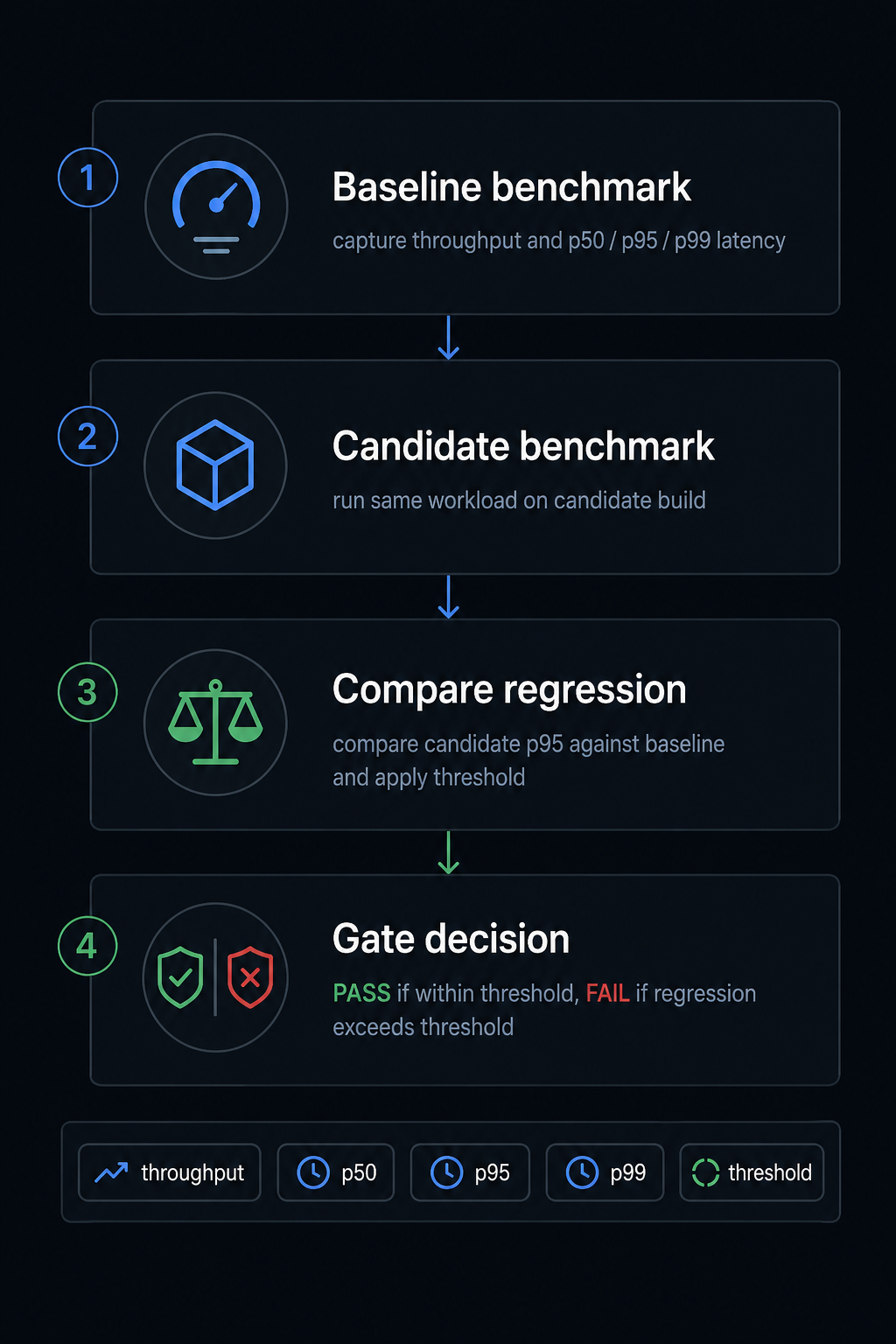
A lightweight CI validation system for inference-style workloads. It benchmarks baseline and candidate runs, tracks p50/p95/p99 latency and throughput, and blocks meaningful p95 latency regressions before release.
Key Features
- Compares baseline and candidate inference-style benchmark runs
- Tracks p50, p95, and p99 end-to-end latency
- Measures throughput in requests per second
- Runs in GitHub Actions for push, PR, and manual validation
- Includes controlled failure detection for reproducible regression testing
Regression Policy
- Compares candidate p95 latency against baseline p95 latency
- Fails when candidate p95 regresses by more than 10 percent
- Requires at least 1.0 ms absolute regression to avoid runner noise
- Separates normal pass validation from controlled failure detection
- Uses JSON configuration so thresholds can be tuned without changing code
Latest GitHub Actions Results
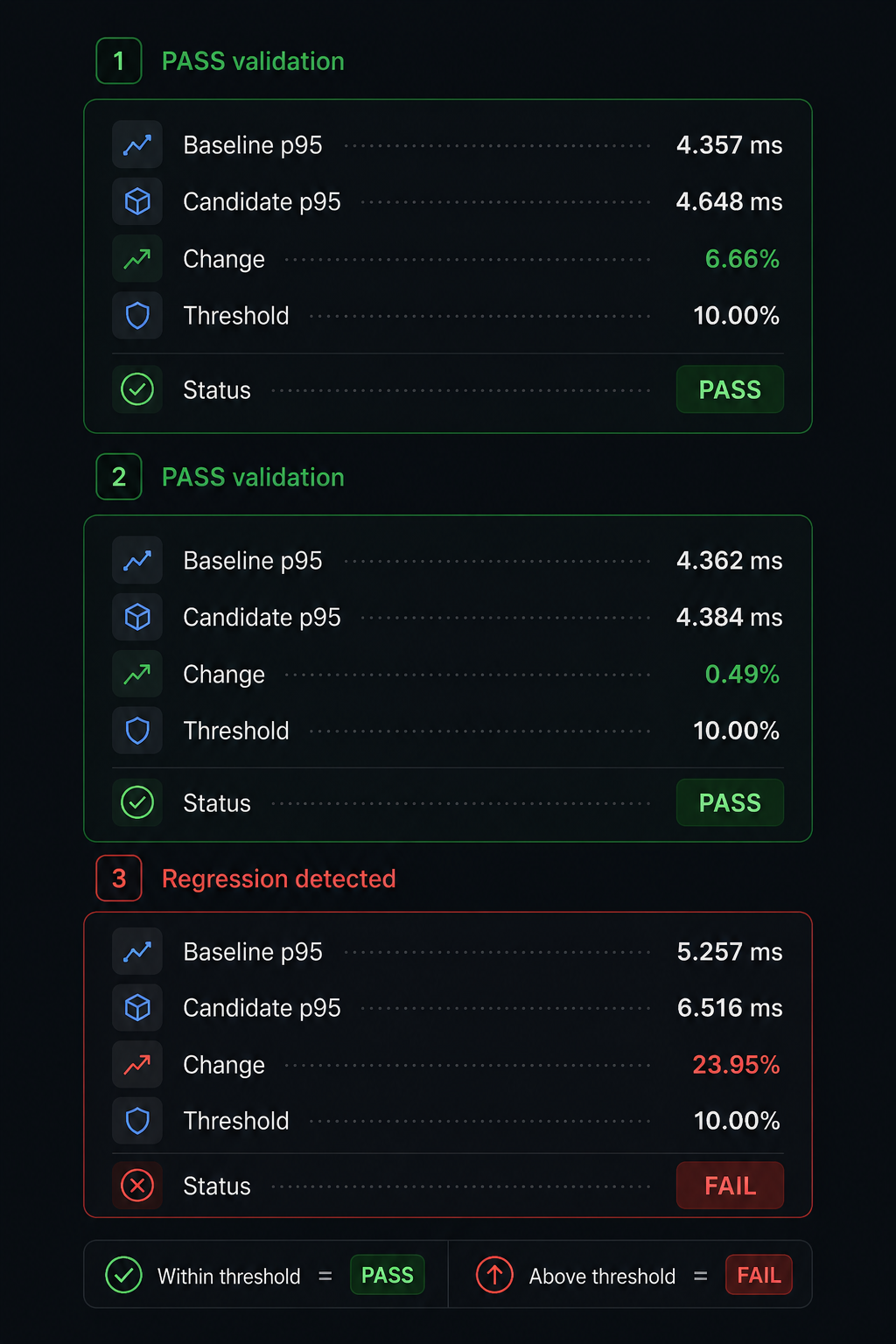
- Default gate passed with 0.290 ms absolute p95 change
- Manual pass gate passed with 0.021 ms absolute p95 change
- Controlled regression demo detected a 1.259 ms p95 regression
- All workflows completed successfully with expected validation behavior
Regression Gate Output
=== Default Regression Gate ===

Workflow: push / pull request validation
Stage: end_to_end_ms
Metric: p95_ms

Baseline throughput:   233.24 req/s
Candidate throughput:  219.38 req/s

Baseline p50:          4.260 ms
Candidate p50:         4.537 ms

Baseline p95:          4.357 ms
Candidate p95:         4.648 ms
Change:                6.66%
Absolute change:       0.290 ms
Percent threshold:     10.00%
Minimum floor:         1.000 ms
Status:                PASS

=== Manual Pass Gate ===
Workflow: manual passing-path validation

Baseline p95:          4.362 ms
Candidate p95:         4.384 ms
Change:                0.49%
Absolute change:       0.021 ms
Percent threshold:     10.00%
Minimum floor:         1.000 ms
Status:                PASS

=== Controlled Regression Detection ===
Workflow: manual failure-path validation

Baseline throughput:   231.46 req/s
Candidate throughput:  157.55 req/s

Baseline p95:          5.257 ms
Candidate p95:         6.516 ms
Change:                23.95%
Absolute change:       1.259 ms
Percent threshold:     10.00%
Minimum floor:         1.000 ms
Checker status:        FAIL
Workflow result:       PASS

Controlled regression was detected as expected.
Highlights
- Built baseline vs candidate benchmark flow for inference-style runtime validation
- Measured p50, p95, p99 latency and throughput for each candidate run
- Implemented configurable regression thresholds using percent and absolute latency floors
- Added controlled regression detection to prove the gate catches meaningful p95 regressions
- Integrated validation into GitHub Actions for push, PR, and manual workflow checks
- Added smoke tests to validate benchmark result structure before trusting outputs
- Documented passing and failure-path behavior with reproducible benchmark results

Performance Validation
- Compare candidate runs against baseline runs
- Track p95 latency as the primary regression signal
- Use absolute floors to reduce CI runner noise
- Block meaningful latency regressions before release

What I Learned
- Performance gates need noise tolerance
- Percent thresholds alone can be too sensitive
- Controlled failures make CI behavior easier to verify
- Functional correctness and performance validation solve different problems

Tech Stack
- Python benchmark and comparison scripts
- PyTorch synthetic inference-style workload
- GitHub Actions workflow validation
- JSON-driven regression threshold configuration